Incógnito
Strategic communication · Spain/International
Redesign of an integrated communications agency’s website as part of a search engine optimisation strategy
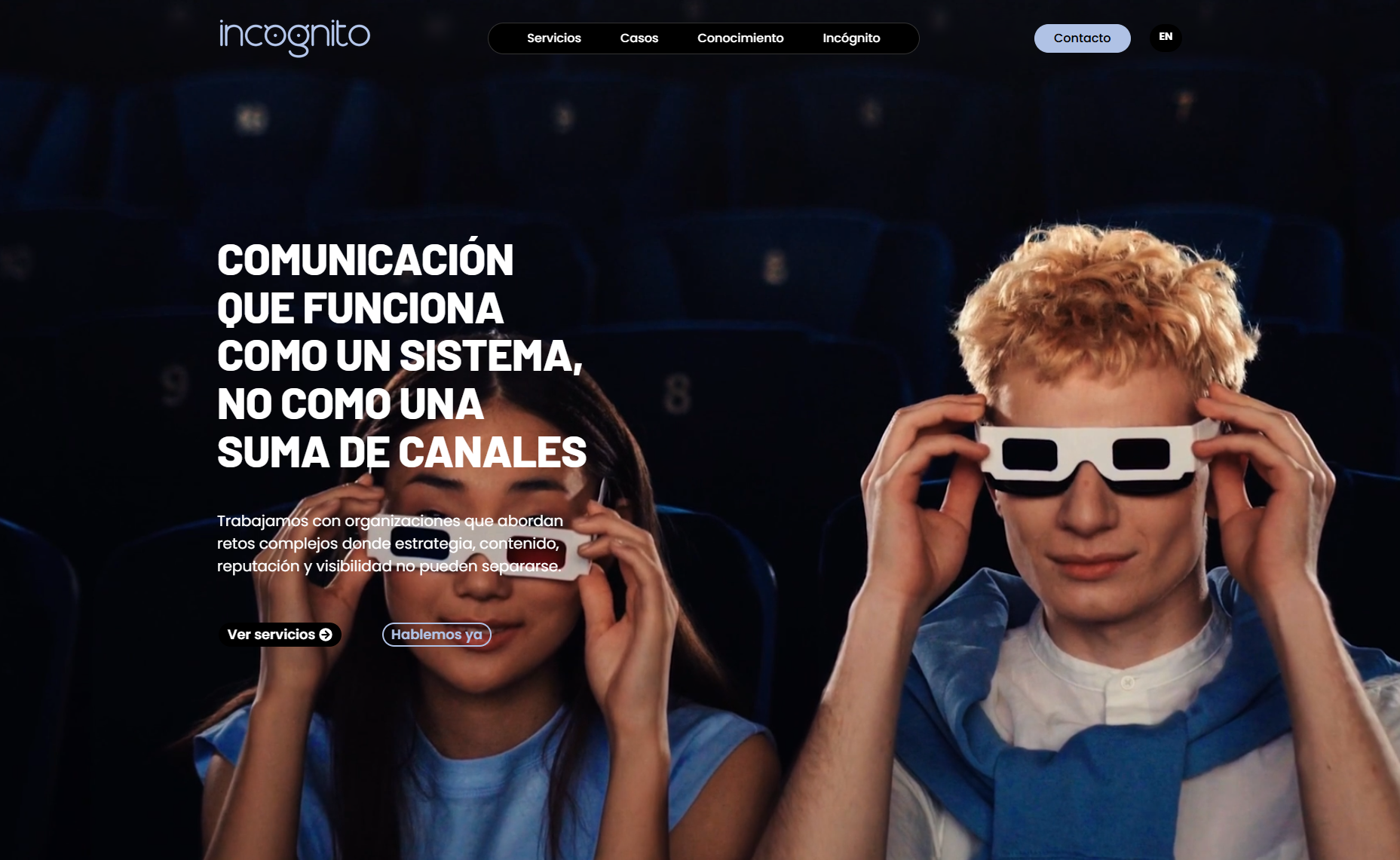
A bespoke project to ensure that the Incógnito website functions just as we sell it: a system in which strategy, content, reputation and visibility work together. It is not merely a showcase for individual services.
The website should explain what Incógnito is today, rather than what it used to be
Incógnito had evolved into an integrated strategic communication model, but its website continued to tell a different story. The services were presented as separate tasks, the language was reminiscent of that used by a digital marketing agency, and the content accumulated over the years (articles, podcasts, press releases) was growing without any underlying logic to tie it all together. Several previous migrations had also left behind duplicate URLs, unconsolidated redirects and content competing with one another for the same search queries. The navigation and design reflected this outdated approach and did not facilitate browsing the website by specialism or moving from a service to its case studies and related content.
The challenge was not to redesign a website, but to rebuild it so that search engines, AI systems and potential clients could understand what Incógnito specialises in, how it works and what problems it has solved. All this had to be achieved in two languages without compromising the authority already established by the existing content.
What was decided and what was ruled out
The strategic decision was to first design a content management system, Incógnito 2.1, and then build the website on top of it. The content was organised into three layers (Services, Case Studies and Knowledge) and four thematic pillars that reflect the agency’s areas of expertise: strategic and integrated communication; influence, reputation and public legitimacy; content as a positioning infrastructure; and SEO, GEO and authority architecture. Each piece has a place, a pillar and a defined relationship with the others.
It was also decided that the success stories would recount decisions rather than lists of tasks: what the challenge was, what was chosen and what was ruled out. And that all the language on the website, from the copy to the metadata, would reflect strategic communication rather than tactical marketing jargon.
In terms of design and user experience, these were developed after the architecture: first wireframes by page type, followed by the visual design. The menu was reduced to four entries (Services, Case Studies, Knowledge and Incognito) and each page was designed to lead to the next decision.
Finally, the idea of transferring the blog as it stood to the new website was rejected. Each piece of content was reviewed to classify it under a pillar, rewrite it, merge it or remove it. In terms of design, complex interactive formats for presenting the services were rejected in favour of simple formats that are mobile-friendly and free from blocks of repetitive information.
Comprehensive website redevelopment project
Content architecture: we defined the Incógnito 2.1 editorial system, comprising four pillar pages, pillar posts for each pillar, and rules for internal linking between layers, so that each piece of content reinforces the overall thematic authority of the site.
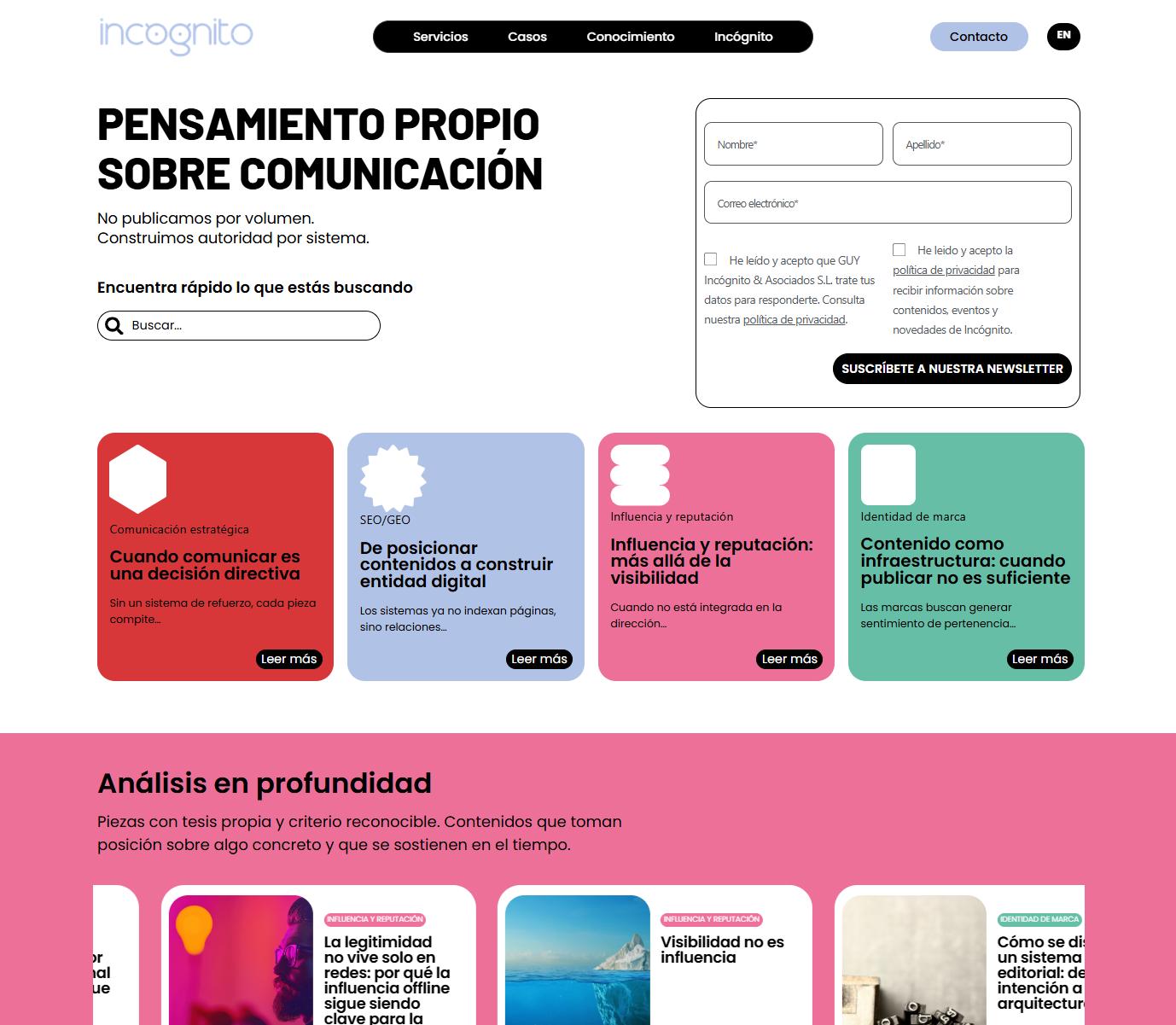
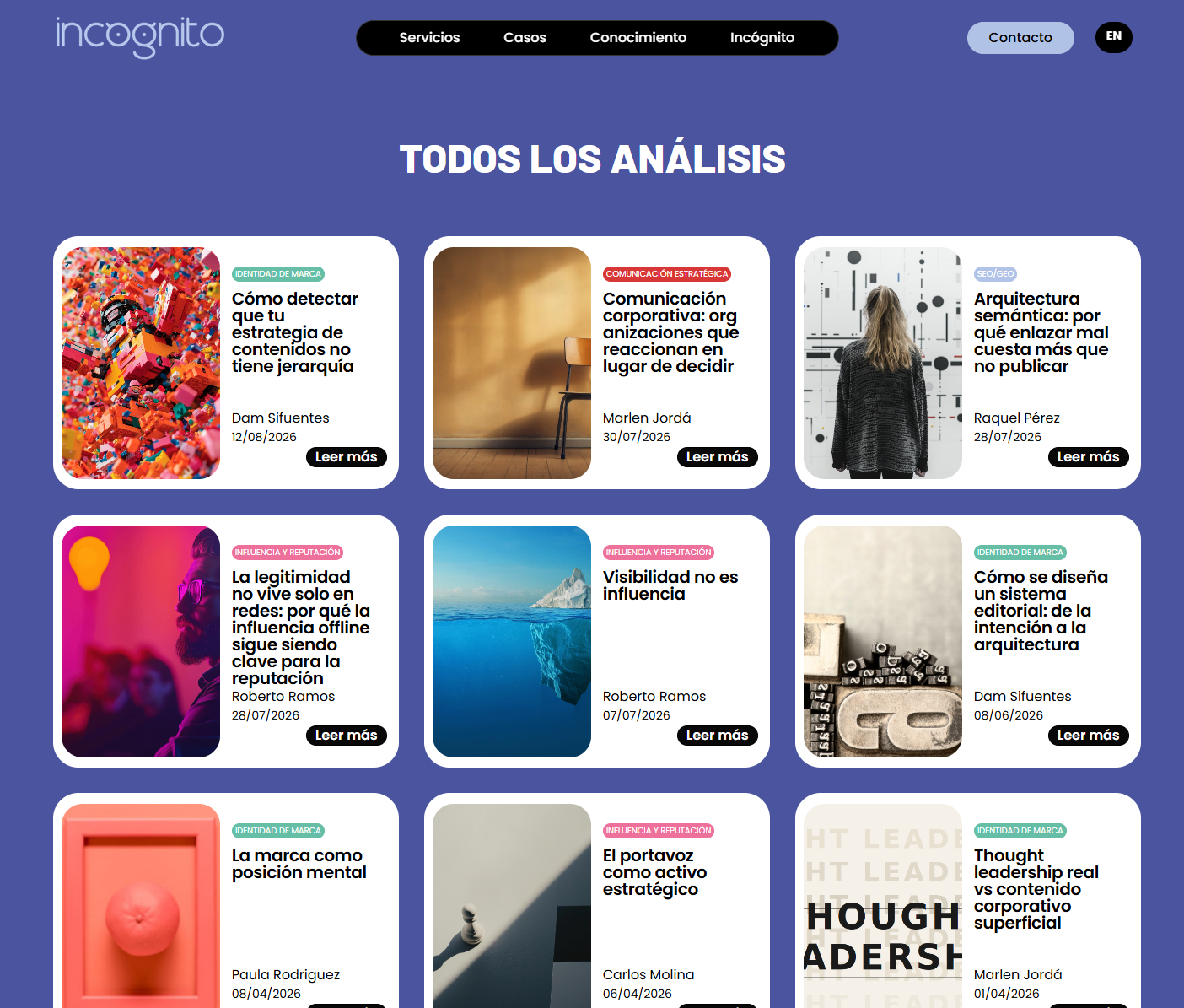
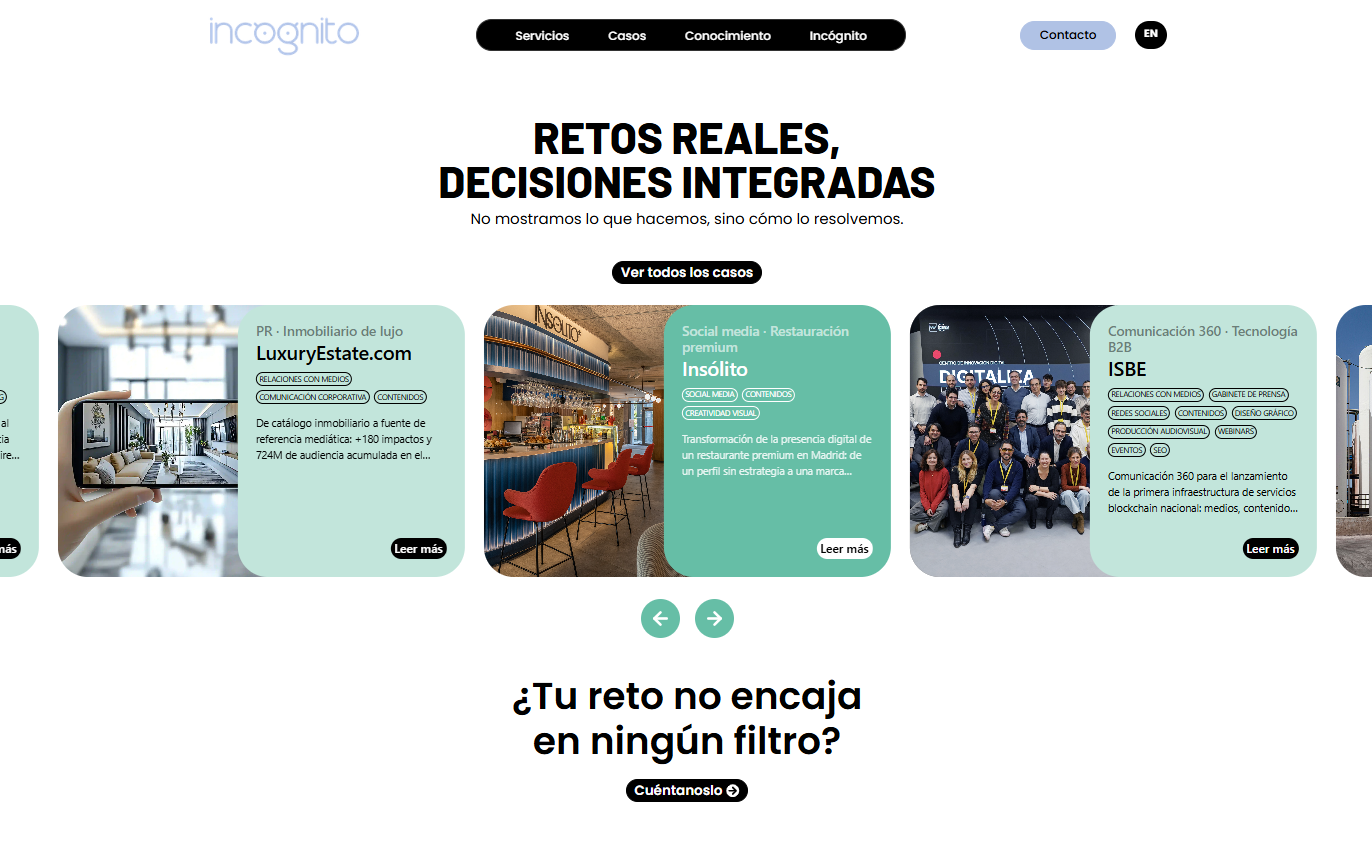
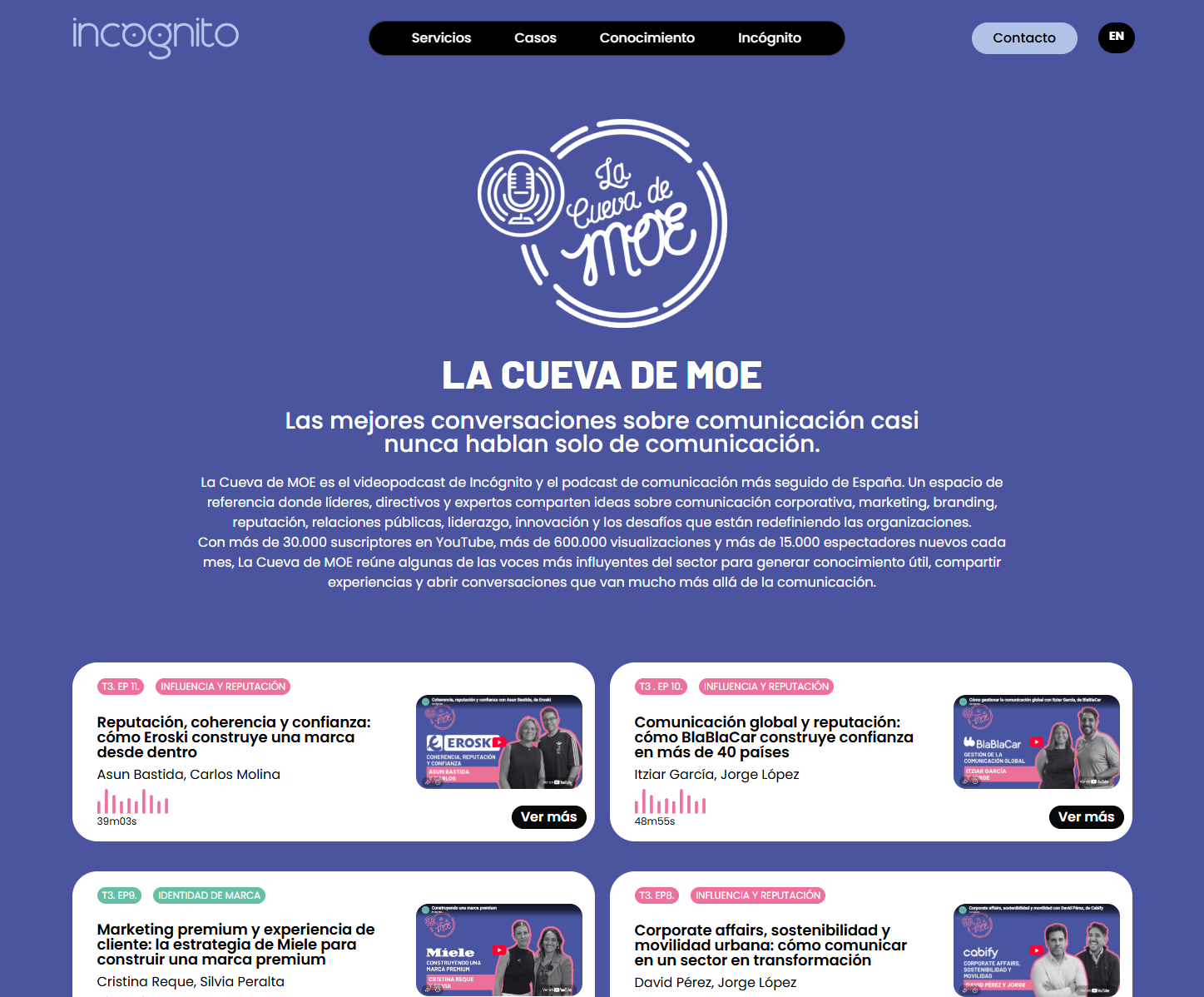
Design and user experience: we designed the wireframes for each page type and a library of reusable components; a case studies hub with filters by type of challenge and by service; a Knowledge hub organised by pillars with an integrated podcast; as well as carousels linking case studies and services in both directions, all under a single visual system in both languages.
Service pages: we wrote and designed the seven service pages from scratch using a common structure, dynamically linked to the success stories for each area.
Success stories: we rewrote the existing stories in a narrative format covering the challenge, strategy, tactics and results, and incorporated new stories.
Review of legacy content: we audited the published content to reclassify it into pillars, update it or remove it, and built the 301 redirect map that resolved the technical debt from previous migrations.
Technical SEO and GEO: we configured metadata, structured organisation data, the llms.txt file for AI assistants, and author pages linking each professional to their specialism, to reinforce who is speaking and from where.
Bilingual website: we adapted all content into English, with dedicated URLs, metadata and internal linking for each language.
Metrics: we rebuilt the tagging and analytics system to reliably measure traffic behaviour on the new architecture.
Results
The new architecture has transformed the quality of visits coming from search engines. Visitors arriving via Google find a website organised by specialism and spend more time on it, view more content and engage with it more. On Google, the website appears in search results more closely related to what Incógnito does, with a higher average ranking and a higher click-through rate.
“Applying the same approach to our own website that we use with our clients forced us to decide who we are and where we set the standard. Today, the website doesn’t simply list services: it demonstrates a way of working.”